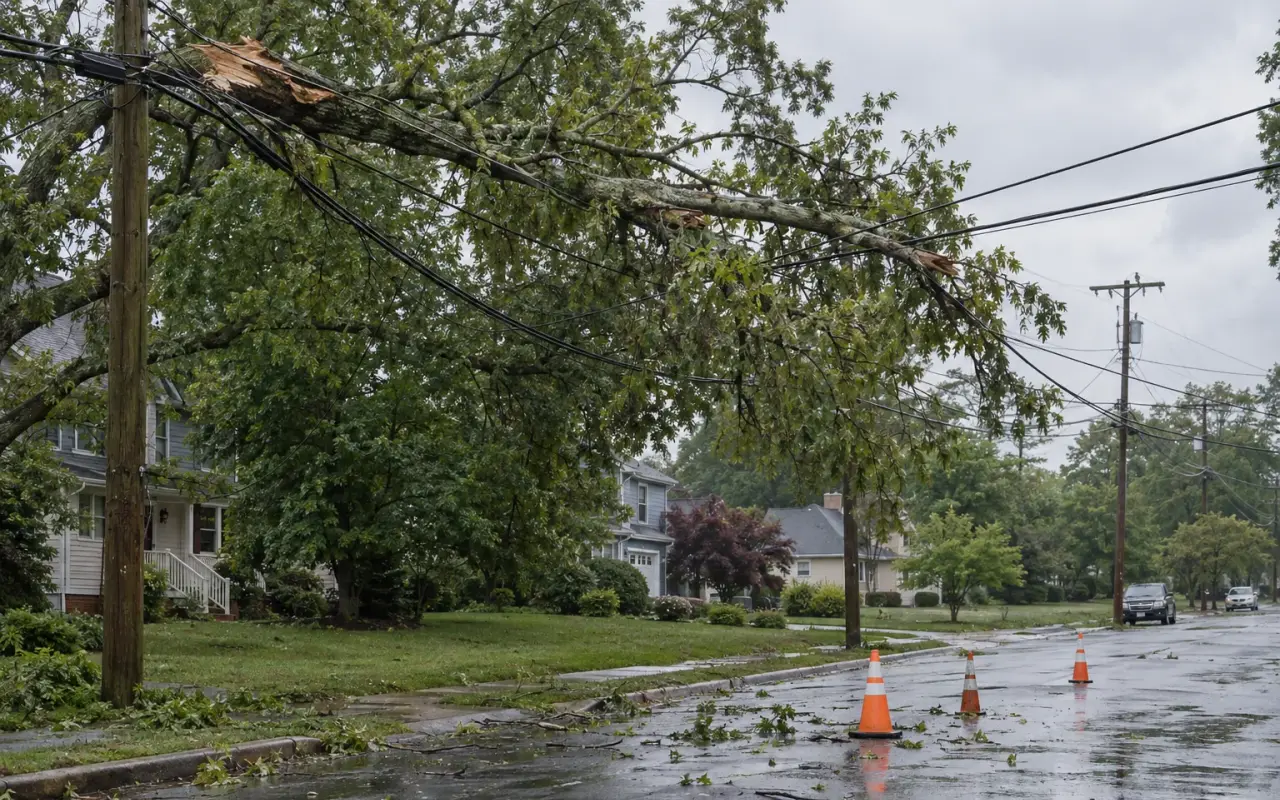
Stay away and call the utility
This is the one situation where the first call is not to a tree service. The International Society of Arboriculture puts it without qualification:
Never attempt to remove branches or any tree part from or near power lines, and never go near downed power lines! These lines are especially dangerous, as they could still be conducting electricity. If you see tree parts in contact with utility lines, call your local electricity provider.
International Society of Arboriculture, Recognizing Tree Risk
Keep people, pets and cars well away from the tree, the line and anything touching either, including a wet lawn, a fence or a gutter the line has fallen across. If someone is hurt or there is fire or sparking, call 911.
Every town and county page on this site names the electric utilities that serve that county, from the Energy Information Administration’s 2024 records. Each utility publishes its own number for outages and downed lines.
Why trained crews only
The rule for tree crews is the same as the advice to homeowners. OSHA’s quick card for tree trimming and removal begins “Assume that All Power Lines Are Energized!” and says:
All tree trimming or removal work within ten feet of a power line must be done by trained and experienced line-clearance tree trimmers.
OSHA QuickCard, Tree Trimming and Removal
It also tells crews to “contact the utility company to discuss de-energizing and grounding or shielding of power lines.” A tree service that offers to cut a limb off a live line without the utility is offering to break that rule.
Which line is it?
The ISA brochure on trees and utilities describes the wires on a typical pole from the bottom up:
- Communication lines, the lowest, carry phone, cable or internet. They “are not designed to carry electricity but can become energized.”
- Secondary lines carry household voltage, 120/240 volts. Many are insulated. The line from the pole to your house is one of these.
- Primary lines sit above them, often at the top of the pole or on cross arms.
- Transmission lines, on taller structures, carry far higher voltages.
Tell the utility which one the tree is on, as well as you can tell from a distance. It changes who comes out and how fast.
After the line is safe
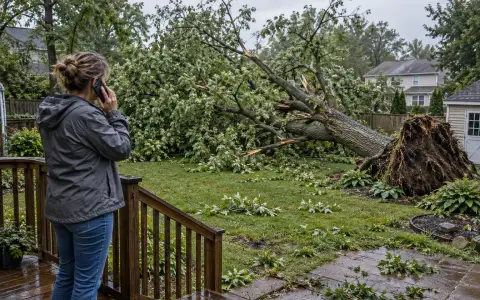
Once the utility has made the line safe, what is left is a tree on your property: on the lawn, on a fence, on the house. Ask the utility what it will clear and what it leaves; utilities differ, and the answer often depends on whose tree it was and which line it hit. Whatever remains on your side is a job for a tree service, and if the tree also damaged the house or a car, the steps on those pages apply. A tree on the house · A tree on a car
Updated 2026-10-11.
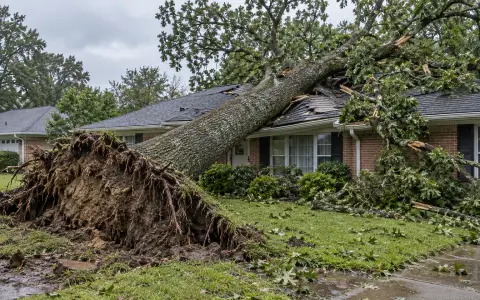 On the house or roof
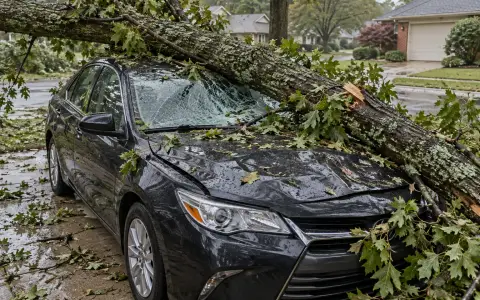 On a car
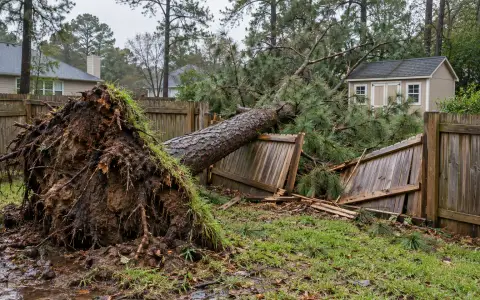 On a fence or shed
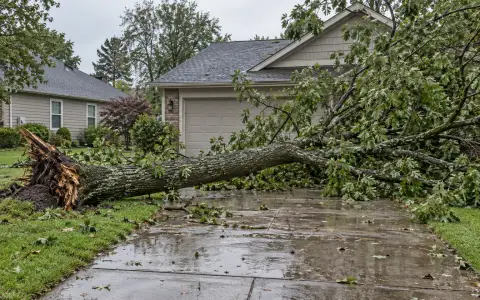 Across the driveway or road
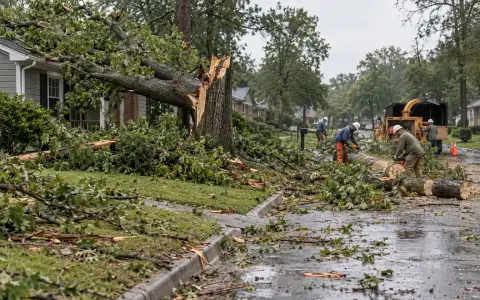 After a storm
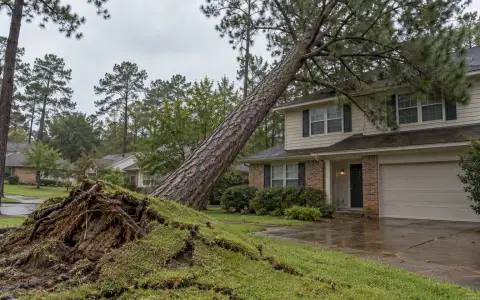 Leaning
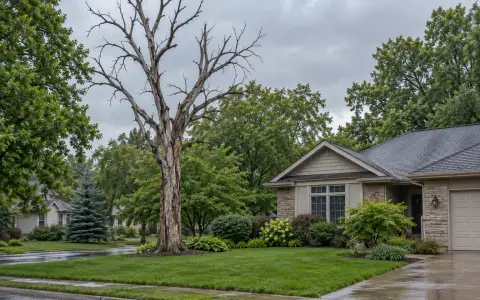 Dead or dying
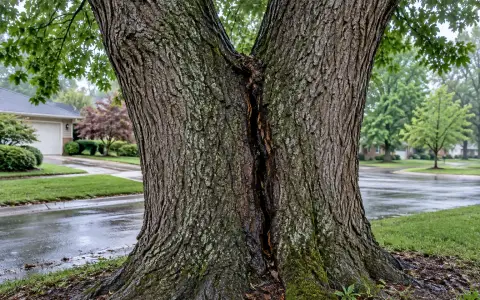 Split or cracked trunk
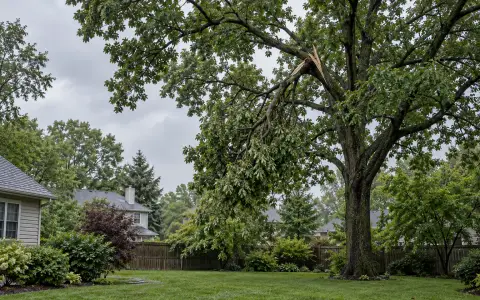 Hanging broken limb
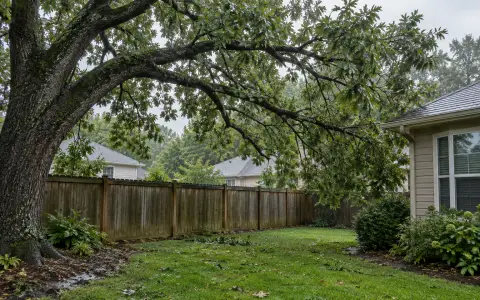 A neighbor’s tree